Most growth agencies do not have a reporting problem.
They have a context problem.
That may sound counterintuitive at first, especially in a world where nearly every client engagement begins with dashboards, attribution, CAC trends, conversion reports, funnel analysis, and weekly KPI reviews. Those things matter. They are necessary. But they are not sufficient.
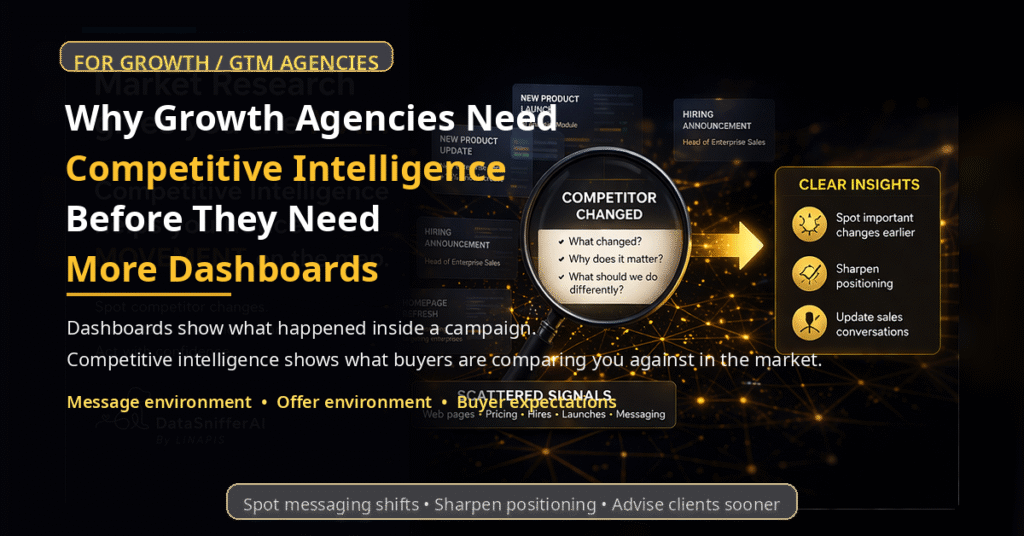
A dashboard can tell you what happened inside a campaign. It can show you which ad set underperformed, where conversion rates dipped, where traffic quality changed, or which landing page lost momentum. What it cannot do, on its own, is explain what changed around the campaign.
It cannot tell you what your client’s buyers started seeing from competitors last week.
It cannot tell you that three rival companies quietly changed their homepage messaging, repositioned their offer, launched a new proof angle, updated pricing language, introduced a comparison page, or shifted from feature-led messaging to outcome-led messaging.
And in many cases, those outside changes shape campaign performance more than the agency realizes.
That is why competitive intelligence deserves to enter the conversation earlier than it usually does. Not as a side research exercise. Not as a quarterly deck. Not as something the strategy team glances at once in a while. But as an operating input into how growth decisions are made.
Because before an agency needs more reporting, it usually needs better market context.
Dashboards tell you performance. Competitive intelligence tells you pressure.
That distinction is easy to miss.
Most agencies are very good at measuring performance inside the systems they control. They know how to read platform data, run tests, interpret funnel drop-off, and optimize the mechanics of acquisition. But buyers do not make decisions inside HubSpot, Google Ads, or a reporting dashboard. They make decisions in the market.
They compare.
They browse.
They hear multiple claims.
They absorb repeated language patterns.
They begin to expect certain proof points.
They notice pricing structures.
They respond to the way vendors frame risk, urgency, trust, and value.
That means performance is always happening inside a competitive context, whether the agency is studying that context or not.
When an agency is only looking inward, it often misdiagnoses what is happening. It assumes the issue is creative fatigue, poor targeting, a weak CTA, or declining channel efficiency. Sometimes that is true. But many times, the real issue is that the market moved and the strategy did not.
The campaign did not fail in isolation. It became less relevant in comparison.
That is a very different problem.
The hidden weakness in many growth programs
A lot of growth teams operate with an optimization-first mindset.
Something drops, so they test angles.
Lead quality dips, so they refine targeting.
CPL rises, so they adjust spend.
Landing page conversions soften, so they change structure, copy, or UX.
Again, none of that is wrong. But optimization without market context can become a highly efficient way of solving the wrong problem.
If your client’s competitors are changing the narrative buyers are exposed to, your internal metrics alone will not explain that clearly enough.
For example, imagine a B2B SaaS client whose demos start declining after months of stable performance. The agency might assume the audience has saturated, the creative has worn out, or the offer needs stronger urgency. Those are reasonable first hypotheses.
But what if the real change is this: the top competitors have all started emphasizing implementation speed, while your client still leads with feature depth? Or the competitors have begun speaking directly to CFO concerns while your client is still speaking mainly to practitioners? Or they have reframed the category from “automation” to “risk reduction,” and buyer expectations have shifted with it?
None of that shows up neatly in a standard dashboard.
But all of it affects response.
This is where competitive intelligence becomes less about “keeping an eye on competitors” and more about understanding the message environment buyers are entering before they click, compare, or book.
Growth decisions are rarely made in a vacuum
The best agencies do not just improve channel performance. They improve strategic fit.
That means they are constantly asking questions like:
- What is the buyer seeing elsewhere before they arrive here?
- Which claims are now becoming table stakes in the category?
- What language patterns are getting repeated across the market?
- Which competitors are changing pricing, positioning, proof, or packaging?
- Where is there message sameness?
- Where is there a chance to create sharp contrast?
Those are not abstract branding questions. They are growth questions.
Because if ten competitors are all saying roughly the same thing, the agency’s job is not just to amplify the client’s message harder. It is to help the client say something that lands differently and matters more.
And if a buyer is comparing multiple options before ever speaking to sales, then market context is not a “nice-to-have.” It is part of conversion strategy.
A real example: when the problem is not the campaign
Let us take a realistic scenario.
A demand generation agency is working with a cybersecurity SaaS company. Over six weeks, paid acquisition gets more expensive. Lead costs climb. SQL quality softens. The first instinct is familiar: the team assumes the creative is tiring out and the campaign needs fresh hooks.
That is a common reaction, and often a useful one.
But before rebuilding the campaign, the team reviews competitor websites, paid messaging, landing pages, and recent positioning changes. What they find changes the diagnosis completely.
Several competitors have shifted away from broad “threat detection” language and moved toward board-level risk language. Instead of speaking only about security operations, they are framing their offer around audit readiness, compliance exposure, business continuity, and executive accountability.
In other words, the market conversation changed.
The client’s existing messaging was still technically correct, but it was no longer matching the level at which buyers were evaluating urgency and value.
So the agency changed the offer framing. They adjusted ad hooks. They rewrote landing page language. They introduced stronger business-risk proof points and aligned the positioning to what buyers were now primed to care about.
Pipeline quality improved without increasing spend.
That is the kind of result agencies often attribute to better optimization. But the real win came earlier, from a better read on the market.
Another example: when “better reporting” would not have solved the issue
Consider a RevOps and GTM advisory agency working with a B2B software client in a crowded category.
The client’s outbound performance starts weakening. Email reply rates fall. Sales conversations stall. The agency could easily respond by changing sequences, testing subject lines, or reviewing ICP segmentation.
But a competitive review reveals that multiple rivals have begun offering category-specific implementation playbooks and highly visible customer proof for narrow verticals. Meanwhile, the client is still presenting itself in broad, generic language.
The issue is not just outbound execution. It is perceived relevance.
The agency responds by helping the client tighten vertical messaging, create sharper point-of-view assets, and restructure outreach around specific operational pains buyers can recognize immediately.
Response quality improves not because the sequence got more clever, but because the message got more market-aware.
That is a critical lesson for agencies: many growth problems are not execution failures first. They are context failures first.
Why agencies often underuse competitive intelligence
One reason is practical.
Competitive research is time-consuming. It usually lives in scattered docs, screenshots, bookmarks, Slack threads, call notes, teardown decks, and random observations from client meetings. It is hard to maintain consistently. Harder still to convert into something useful enough to influence day-to-day decisions.
Another reason is structural.
In many agencies, reporting is operationalized but competitive intelligence is not. Reporting has owners, routines, dashboards, templates, and recurring meetings. Competitive intelligence is often informal. Somebody checks a few sites before a workshop. Somebody notices a pricing page change and mentions it in passing. Somebody saves a competitor ad and forgets to connect it to strategy later.
So the insight never compounds.
The agency remains reactive.
And when strategy discussions happen, the team may rely too much on internal performance data and not enough on the market dynamics shaping that performance.
The result is predictable: dashboards become more detailed, but decisions do not necessarily become better.
What competitive intelligence should actually help an agency do
The goal is not to collect more information.
The goal is to improve decisions.
For a growth or GTM agency, competitive intelligence is useful when it helps answer questions like:
1. Should we change the message?
Not because it sounds nicer, but because buyers are now responding to a different framing in the market.
2. Should we change what proof we lead with?
Not because a landing page feels outdated, but because competitors are raising the proof standard and buyer expectations are shifting.
3. Should we change how the offer is packaged?
Not because internal metrics suggest a conversion tweak, but because competitor packaging is redefining what “normal” looks like.
4. Should we change what we optimize for?
Not because the dashboard needs a new KPI, but because the buyer journey itself is changing in response to the competitive field.
5. Should we advise the client differently?
Not based only on what happened last month in-platform, but based on what is happening now in the category.
When CI supports those decisions, it becomes operationally valuable.
What growth agencies should start doing differently
Most agencies do not need a massive research department to benefit from competitive intelligence. They need a more disciplined habit of bringing outside context into core decision-making.
A simple starting model looks like this:
Review the top competitors before changing channel tactics
Before making major campaign changes, study what buyers are likely seeing elsewhere. Look at homepage messaging, offers, proof points, pricing signals, demo CTAs, category pages, case studies, and recent launches.
Track repeated claims across the market
If the same promises, words, or value angles keep appearing, that tells you what buyers are being conditioned to expect. It also tells you where the category may be becoming crowded and undifferentiated.
Look for contrast before optimization
Agencies often jump straight to incremental improvement. But sometimes the bigger opportunity is not improving a weak message. It is creating a sharper one.
Watch for strategic shifts, not just updates
A competitor publishing a blog post is not necessarily important. A competitor changing who they seem to be selling to, what they emphasize, how they package value, or what proof they prioritize—that matters more.
Use CI to sharpen client recommendations
Competitive intelligence should not stay in a side deck. It should influence messaging reviews, campaign planning, landing page strategy, sales enablement, and executive recommendations.
That is when it starts creating leverage.
The bigger strategic point
Agencies are not paid only to operate channels.
They are paid to help clients make better bets.
That means understanding not just what happened inside campaigns, but what changed outside them. It means seeing the competitive context that clients are too busy to monitor themselves. It means connecting signal to implication.
When an agency can do that well, it becomes more than a service provider. It becomes a strategic interpreter of the market.
And in a noisy category, that role becomes extremely valuable.
Because clients do not just want reports. They want judgment.
They want help understanding why performance is changing, what it means, and what should happen next.
Dashboards support that. But they do not replace it.
Where a tool like DataSnifferAI can realistically help
This is exactly the kind of workflow I am building DataSnifferAI to support.
Not as a replacement for agency strategy. And not as another noisy monitoring system that floods teams with updates they do not need. The practical goal is simpler than that: help growth and GTM agencies surface meaningful competitor shifts faster, so they can interpret what changed and respond with clearer strategy.
That means tracking competitor messaging changes, offer changes, positioning shifts, visible proof updates, and market-facing signals that might actually influence how a buyer compares options. Then the value is not in “more data.” The value is in reducing the time it takes to go from market movement to usable strategic insight.
For agencies, that can mean fewer hours spent manually checking competitor pages, fewer strategic blind spots between reporting cycles, and a better basis for advising clients when something in the market starts moving. That is the real gap I am trying to solve with DataSnifferAI. No fluff, no fantasy—just a practical way to make competitive context easier to notice and easier to use.
Explore here: https://linapis.com/datasnifferai